
AIMIX Construction Machine Solutions
Less Assembly on Site: The Real Value Behind a Factory-Ready Portable Batching Plant
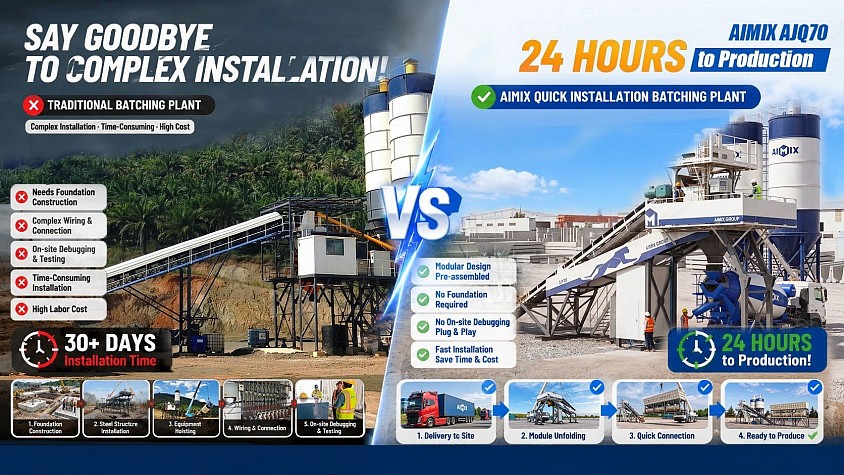
A portable concrete batching plant is often promoted for its mobility, compact structure, and ability to serve projects in changing locations. Yet another characteristic can be equally consequential: how much of the plant is already prepared before it reaches the construction site. Traditional equipment may arrive as numerous components requiring extensive assembly, alignment, wiring, and commissioning. The machinery itself may be capable, but the project must spend considerable time turning separate parts into an operational system. A factory-ready portable batch plant for sale approaches this problem from a different angle. More components can be preassembled, tested, and configured before shipment, shifting a substantial portion of the installation workload from the construction site to a controlled manufacturing environment. The value is therefore not simply “faster installation.” It is the reduction of site-based uncertainty, labor requirements, commissioning complexity, and idle time before concrete production begins.
Why On-Site Assembly Becomes a Hidden Construction Cost
When a batching plant arrives at a project site, assembly can involve much more than mechanical installation. Supporting structures may need to be positioned, components aligned, electrical systems connected, control systems configured, and individual units tested. Every additional assembly procedure requires labor, tools, lifting equipment, and technical supervision. For a large permanent plant, these requirements may be acceptable because the equipment is expected to remain operational for years. For a portable plant intended for temporary, remote, or rapidly deployed projects, however, excessive installation work can undermine one of its primary advantages: mobility.
A factory provides a controlled environment. Construction sites do not. Weather, uneven ground, limited lifting access, material congestion, temporary power supplies, and shortages of skilled technicians can all complicate equipment assembly. Even a straightforward installation procedure can become protracted when several site constraints occur simultaneously.
The more work that must be completed on site, the more opportunities exist for installation errors, misalignment, damaged components, or incomplete connections. These issues may not become apparent until commissioning begins. Factory preparation shifts much of this complexity into a controlled production environment, where tools, technicians, testing equipment, and standardized procedures are readily available.
How Factory-Ready Design Reduces Installation Complexity
The central principle behind a factory-ready portable batching plant is straightforward: complete as much work as practical before transportation. Major components can be assembled, connected, inspected, and tested at the manufacturing facility. Instead of receiving a collection of disconnected parts, the contractor receives a system that is substantially closer to operational condition. This creates a more compressed installation process. The difference may appear subtle on a specification sheet, but it becomes tangible once the equipment reaches the project site. Fewer assembly procedures mean fewer working hours and less dependence on temporary installation resources.
Preassembly also creates an opportunity for systematic testing before shipment. Mechanical components can be inspected, electrical connections checked, and control functions verified under factory conditions. This does not eliminate the need for site commissioning. Site-specific installation and final testing remain essential. However, the starting point is different. Instead of troubleshooting a system assembled entirely under field conditions, technicians can focus on final connections, calibration, and operational verification.
A factory-ready configuration can reduce the number of unknowns encountered during startup. This is particularly valuable when technical support is difficult to access or when the project schedule leaves little tolerance for commissioning delays. The plant arrives with a greater degree of operational maturity.
Portability is sometimes interpreted simply as the ability to move equipment from one location to another. In practical construction, however, portability has several dimensions. A genuinely mobile batching plant for sale should be relatively easy to transport, install, operate, dismantle, and relocate. If the first installation requires extensive labor and specialized equipment, the cost of relocation may become disproportionate to the benefits of mobility. Factory-ready construction strengthens the entire mobility cycle.
Why Faster Commissioning Creates Broader Project Value
The most obvious benefit of simplified assembly is time. But the real value of time lies in what it allows the project to accomplish. A batching plant that enters production earlier can support concrete works sooner. Foundations, columns, slabs, roads, drainage structures, and other activities dependent on concrete supply can proceed according to the planned sequence. In fast-track projects, this can be decisive. A few days saved during equipment installation may prevent a much larger scheduling disruption later because concrete production often sits near the center of multiple interconnected construction activities.
Complex installation can require experienced electricians, welders, mechanical technicians, lifting operators, and commissioning specialists. Mobilizing these personnel to a remote construction site can be expensive and logistically cumbersome. Factory-ready equipment reduces the amount of specialist work required after delivery.
On remote sites, labor shortages can become more problematic than equipment shortages. Skilled technicians may need to travel long distances, arrange accommodation, or remain on site for several days. Reducing assembly requirements can therefore produce savings beyond direct labor costs. It can simplify project logistics and reduce the amount of time specialized personnel need to remain deployed.
The purchase price of a portable batching plant tells only part of the economic story. Installation labor, lifting equipment, commissioning time, transportation, temporary infrastructure, and potential delays all contribute to the actual deployment cost. A factory-ready plant may command a higher initial price than a more basic configuration. Yet if it substantially reduces site assembly and startup requirements, the difference can be recovered through lower deployment costs and earlier production. The more frequently a plant is moved between projects, the more important this calculation becomes. Ultimately, the real value of a factory-ready mini concrete batching plant lies in what happens before and after delivery. More work is completed in the factory, fewer tasks remain for the construction crew, and the transition from transportation to concrete production becomes more direct. The concept is simple but consequential: **the best portable equipment is not merely easy to move; it is easy to put into operation.** By reducing on-site assembly, factory-ready design can shorten installation, simplify commissioning, reduce dependence on specialized labor, and protect construction schedules. For contractors operating under tight timelines or difficult site conditions, that operational simplicity can be worth considerably more than the apparent savings offered by a lower-priced but assembly-intensive alternative.